Scientific Flaws & Counter-Evidence
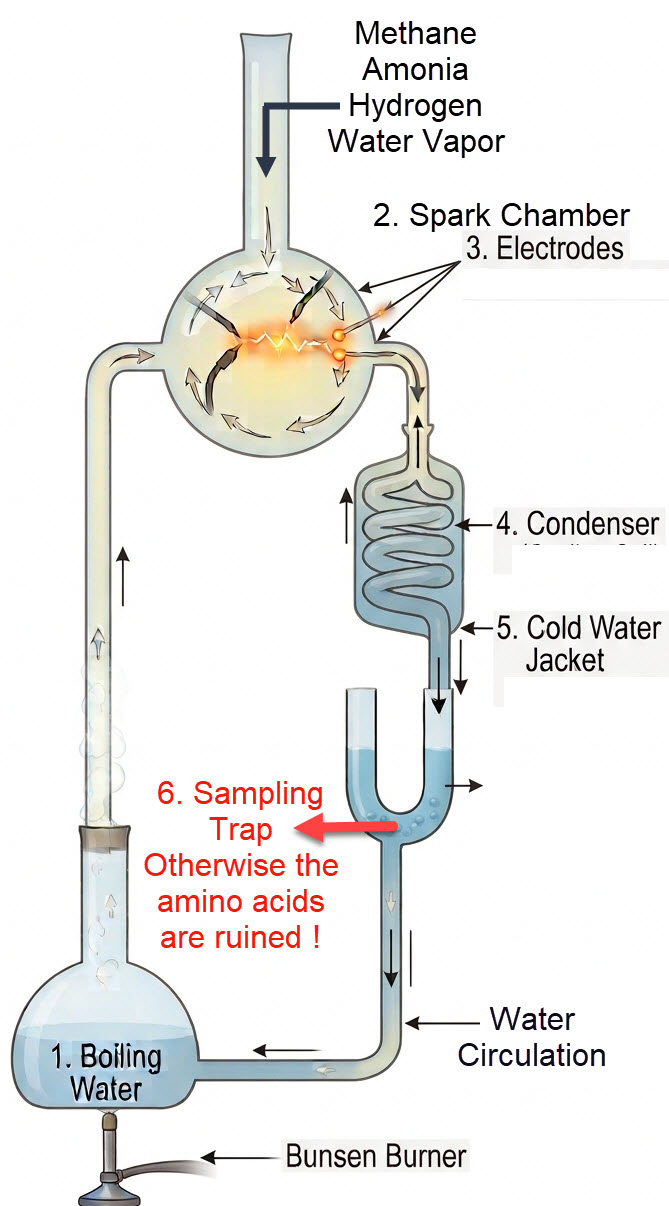
1. Intelligent Intervention (The Trap)
The apparatus included a specialized "trap" designed by the scientists to isolate the amino acids immediately after formation. Without this deliberate human intervention, the amino acids would have been destroyed. This alone is enough to invalidate this as a way amino acids could form in nature.
2. The Left Handed Problem
Life requires exclusively "left-handed" amino acids to build proteins (with very few exceptions). The Miller-Urey experiment produced a 50/50 mixture of left and right-handed amino acids. A random mixture like this is useless for building proteins naturally.
3. Wrong Atmospheric Composition
Miller and Urey used an artificial highly reducing atmosphere consisting of methane, ammonia, and hydrogen. Later scientific consensus does not support this. Note: They excluded oxygen. Oxygen would damage molecules needed for life.
Building Blocks Are Not Blocks Built
Even if the experiment had successfully created pure biological amino acids under realistic conditions, it would still fall short of explaining life. Amino acids are merely letters; they are not a book.
- No Genetic Code: Random amino acids possess no information, sequence direction, or self-replicating mechanisms.
- The Polymerization Barrier: In water, individual amino acids naturally separate from one another rather than bonding together to form proteins.